Are All Children from the Examples Gifted?

by Hanna Vock


Many children are described in the manual. Are they all highly gifted? I’m sure not.

However, they all belong (estimated) to the children of extraordinary ability; thus we call the children, who have an intelligence quotient of at least 115 points. The mean value for all children is 100.

For more information on the distribution of intelligence and the intelligence quotient, as well as the relationship between intelligence and talent, see:

Gaussian Distribution of Intelligence

Giftedness – a Definition

Where Do the Extraordinary Abilities Come from? Giftedness or Superb Advancement?

Above Average or Gifted?

What Is intelligence?

Giftedness and High Intelligence

Most of the children who appear in the articles I have written are highly talented and tested. Often their testing took place years after the described events and confirmed the assumption.

During my many years of working with gifted children, I was able to learn to assess whether giftedness is present. Gifted children catch my eye quite quickly; and I can also advise colleagues and parents unerringly if their child is clearly not highly gifted or is near to giftedness. Concrete observations (from myself, colleagues or parents) and/or direct interaction with the child are sufficient for this.

To obtain a numerical value (for example an IQ value), a test is of course necessary. But such a figure is as imprecise as a good estimate based on precise observations and great experience.

A value measured in the test, for example IQ 130, can just as well represent an actual IQ of 125 or 135 due to the measurement inaccuracy included in the test. The result 130 simply means that the real intelligence is probably close to 130. Tests have not yet been able to measure more accurately. Different tests have different measurement inaccuracies. The tester knows them, they are indicated in the test material and they should also be referred to in a report that the parents receive.

The examples from the manual contributions of the other authors describe both highly gifted children and children of extraordinary ability.

The selection of the children is made in this way:
After the first seminar phase in the two-year IHVO Certificate Course, all participants are given the task of selecting a child from their group / kindergarten for their first practical homework assignment. It should be a child who has already attracted attention through striking developmental advantages and / or conspicuously intelligent questions or ideas or through particularly intelligent playing behaviour that is unusual for the age group. In some cases, the selection could already be based on a test result.

In purely mathematical terms, not every kindergarten group can have a highly gifted child. (Statistically, there are two to three highly gifted children per 100 children.) However, the probability that the participant will find a highly gifted child in her group shifts due to two factors:

1) Most participants register on their own initiative (in the rarest cases, they are brought up to this by their employer). The motive for the registration is often mentioned: „We have a highly gifted child in our institution and would like to be able to support her/him better“ or: „Parents have already told us on admission that they consider their child to be highly gifted and we would like to be able to deal with it“… or something similar.

2) Some of the participants come from Integrative Focus Kindergartens for the Advancement of Gifted Children, in which several (suspected or tested) highly gifted children have already gathered over the course of time because the parents have chosen this kindergarten specifically for their child.

For these reasons, the number of highly gifted children who can be selected for practical tasks is increasing.

Nevertheless, not every participant finds a highly gifted child in her group – but everyone finds a child of extraordinary ability who can become her „observation child“ in the course and with whom she can make specific experiences in the advancement of the gifted. During the two years of the course she can – especially in exchange with the other course participants – develop an ever better feeling for the type and level of talents.

The pedagogical process, which takes place during the course, then revolves around the recognition – understanding – advancement of children’s giftedness. These three tasks intertwine in everyday pedagogical life and always take place simultaneously.

Phase 1:

At the beginning I pay attention to indicators for special and high talents in the everyday life of the kindergarten.

See: Indicators of Possible Intellectual Giftedness.

When dealing with the child and when getting to know the child for the first time in the first few weeks, I (and colleagues with whom I exchange ideas) notice special developmental advances, astonishing statements and other indicators.

I communicate with the child at his or her observed level of development, thereby giving him or her the signal that I am aware of his or her strengths. It’s how I actively build trust. I offer her/him games and stories that I believe she/he can handle, but that also challenge her/him mentally.

In initial discussions with the parents (with the help of the Questionnaire for Parents) I collect further information and compare it with my own perception of the child. First trust between me and the parents (also on the topic of „special talent“) is built up.

Phase 2:

The continuous perception of the child’s reactions (in conversation, to targeted play offers, to offers by the other children) provide further insight, for example about his/her intrinsic motivations, the interests, the ease of learning and the speed of learning. This allows me to discover further indicators of giftedness.

At this stage, evocative observations play an important role.

See: Modes of Observation and Examples of Evocative Observations.

Phase 3:

When the child has experienced a successful, confirming and challenging communication over a long period of time, she/he will open up and will actively shape its own learning process by asking more questions and making its own suggestions.

This phase is particularly satisfying for both sides (kindergarten teacher and child) and can last until school enrolment, provided that the working conditions in the kindergarten make this possible in the long term.
(See also: Improving Framework Conditions!)


Date of publication in German: 2017, July
Copyright © Hanna Vock, see imprint.


Notes on Using the Manual

  • The manual is a collection of individual contributions on various terms, topics and questions. You can find your way around via the table of contents or via the keyword register, which you can both access from the start page. The table of contents as well as the start page can also be found above each article. In these directories, please double-click on the article of interest to go to the corresponding manual page.
  • Many practical examples or further explanations cannot be found in the table of contents. Please search for these in the sitemap (chapter 0 – German version).
  • The manual is constantly being revised and extended.
    Newly added or heavily revised articles can be found on the start page in the list of new entries, which you can also access via the index of contents, chapter 0.
    The entries in the list are sorted so that you find the last entries right at the beginning.
  • The texts contain links to other texts in the manual that are closely related to what you have just read or offer further explanations. Here, too, you can go directly to the other article by clicking on it.
  • Due to the highly networked structure of the manual, repetitions cannot be completely ruled out. The individual contributions should remain understandable – even separately from each other. We ask you to excuse the disadvantage (possible repetitions) in consideration with the advantages.
  • In many articles you will find a short summary.
  • As far as the language of the manual is concerned, it is to be hoped that they will find little „teacher-talk“. I agree with Schopenhauer on this issue:
    „Think like few people and talk like most people. You need ordinary words and say unusual things.“ (After: Wolf Schneider, Wie Sie besser schreiben (As you better write). In: Die Zeit. Magazin, May 2012, p. 10.
  • In the examples, all children’s names are changed to preserve the anonymity of the children.
  • Please respect the copyright! All contributions are the result of strenuous, committed work and are therefore protected by copyright. (See Imprint.)

Of course, you may use all ideas and materials for your work, provided you carefully state the source. For larger projects, consultation with the IHVO is necessary. (Contact: aznick@gmx.de)

We are interested in your opinion on our manual and on individual contributions, and are also grateful for any suggestions.
(Contact: aznick@gmx.de).

See also: The Becoming of the Manual


Date of publication in German: 2007, May
Copyright © Hanna Vock, see imprint.

Who Made the Manual Possible?


Firstly, the many gifted and particularly talented children I have met and worked with have made it possible. Their peculiarities, their ideas and their constantly astonishing play and learning needs were and are the driving force behind this manual. Thanks also to the many open-minded parents.

Secondly, the many committed kindergarten teachers who have intensively dealt with possibilities for advancement and integration in kindergarten in the IHVO certificate courses (and also after receiving their certificates) have made it possible. Their creative ideas and projects, which they have comprehensibly described and explained in their written papers, are an essential part of the manual.
Thirdly, financing is important.

I would like to express my thanks for this:

– the Imhoff Foundation Cologne, which in 2003-2005 not only supported the first certificate course for the advancement of gifted children in kindergarten, which took place in Germany at all, but also supported further IHVO certificate courses and projects as well as team training and parent counselling discussions in Cologne.

– the Youth Welfare Office of the German City of Remscheid, because it made the first project „Integrative Focus Kindergarten of Gifted Pre-School Children“ financially possible,

– the Peters-Beer-Foundation in the Stifterverband für die Deutsche Wissenschaft (Donors‘ Association for the Promotion of Humanities and Sciences in Germany), which financially supported certificate courses and projects of the IHVO as well as the conceptual design of the manual from 2007 to 2010.

– the participants of our courses who have paid all or part of the remaining participation fees themselves,

– and kindergartens who have paid all or part of the participation fees.

The ideational support provided by numerous people has been and remains to be important.

Thank you very much!

Hanna Vock

See also: The Becoming of the Manual


Publication in German: 2007, May
Translation: Arno Zucknick

Preface

Dear Readers

The requests from many kindergarten teachers and parents of young children for literature that specifically deals with giftedness in kindergarten encouraged me to launch the German handbook in 2007. In the meantime a lot of articles have been translated into English.

I am pleased that its many practical contributions have been very well received in Germany and far beyond.

We are constantly working on this manual so that you will always find new articles on new topics. Enjoy your reading!

First of all, I would like to welcome the pedagogical specialists in kindergartens as readers of the manual.

Dear colleagues,

this manual can help you

    • better understand what gifted kindergarten children need,
    • recognize giftedness,
    • support gifted children in kindergarten better than before.

How can you use this manual?

You can use it to familiarize yourself with the topic if it is new to you. No false shame! Of the more than 2500 kindergarten teachers I interviewed, only 8 had heard about giftedness during their training. According to their own assessment, however, they too had hardly learned anything useful on the topic during their training. I hope that you will be better off with this manual.

You can use this manual to check for yourself to what extent your kindergarten is already suitable for gifted children.

You can use this manual to learn how to improve your work for the gifted children.

Please don’t let yourself be pressured. The manual is the result of many people who have been dealing with the subject for a long time. Even if you can only implement a little of it in your kindergarten for a variety of reasons, this is progress for the gifted and particularly gifted children.

Experience from IHVO courses:
What is good for the approximately 2% of gifted children is also good for the 13% of children with above-average talents.

You can refer to this manual if you would like to get your colleagues interested in the topic.

The manual continuously tries to draw a comprehensive picture of the possibilities of gifted children’s advancement in kindergarten. It is a vision overall, but it is based on real experiences.

Next, I would like to welcome the lecturers at pedagogical technical schools,
universities and pedagogical training institutes as readers of the manual.

Ladies and gentlemen

I would be pleased if this manual provide you with additional motivation and useful material to include the topic of the advancement of gifted kindergarten children in your training courses or your advanced trainings and hence to enrich these curricula further. I am grateful for further suggestions from you and would be very interested in exchanging experiences.

And now I would like to address the parents of (probably or possibly) gifted children as readers of the manual.

Dear parents

Even though the manual is intended for use in kindergartens, I hope that you as parents will also find interesting and inspiring information for the advancement of your child in it.

If you would like to talk to your child’s teachers about what you have read, I would ask you to do the following:

Please keep in mind that the teachers and the kindergarten teachers (at least in Germany) probably did not learn anything about giftedness during their training. So do expect openness, interest and willingness to deal with the topic – but to be fair do do not expect extensive knowledge, experience or know-how in this area.

If you meet an experienced teacher in the field of gifted children, so much the better!

Greetings to the representatives of educational policy and the political administrations of the elementary sector

Ladies and gentlemen

I and the co-authors would be very pleased if reading the manual were to encourage you to consider the learning and developmental needs of gifted children in the educational landscape more effectively than before. On the one hand because of the children’s right to appropriate education and advancement, and on the other hand because of the high potential that gifted children would like to develop and on which the general public depends. Please help to create conditions in the kindergartens that make appropriate advancement possible! These include, among other things: smaller groups, more staff and, in many places, appropriate rooming conditions.

The (gifted) children and their (kindergarten) teachers need your support.

Acknowledgement

I would like to thank everyone who contributed to the development of the manual in one form or another and made its further development possible: especially of course my colleague and co-author Barbara Teeke, the translater Arno Zucknick, the authors and the foundations.
(Many articles in the manual aren’t yet translated by Arno Zucknick, but by DeepL. Sorry! It’s a question of time and money.)

Also important, however, were the people who – even in difficult times – accompanied the development of the IHVO attentively and favourably: I am especially grateful to my husband Jochen Vock, who supports me in every respect, the board and the members of the association as well as especially Dr. Harald Wagner, who has been the secretary of ECHA (European Council for High Ability) and the managing director of Bildung und Begabung e.V. for many years.

I very much hope that everyone involved can be satisfied with the development of the manual.

Hanna Vock
Kindergarten teacher, Educator M.A. and Sociologist M.A.,
Founder of the IHVO and publisher of the manual.

See also: Who Made the Manual Possible?

Date of publication in German: 2007, May
Translation: Arno Zucknick

Rachel: „I Made up a Story and We Want to Show It to You Now!”

by Heike Miethig


Rachel, my observation child, is now 4;8 years old.

Building on Rachel’s linguistic and creative skills (talents), I would like to promote her self-confidence so that she can contribute her knowledge and ideas more easily to the group as a whole.

Read more about Rachel’s talents here: Rachel, 4;6 Years and Rachel and Her Letters.

Reason:

I would like to support Rachel in the linguistic and creative area, because I believe that this is where her particular strengths lie. I would like to challenge her eloquence and narrative pleasure by developing a short story with her and writing it down according to her wording. Rachel should experience that her ideas and ideas find recognition.
This little short story is then painted by Rachel, i.e. written in pictures, in order to present it to a small group. Here I would like Rachel to feel proud that her story is presented.

I want her to have more confidence in her abilities. In order to further develop their creative abilities, I would like to create costumes with Rachel and a small group and select costumes from our pool to dress up the characters of their story according to their ideas. Some props are also to be created in this small group.
In the small group it should then also have the opportunity to express the ideas of its history and to communicate them linguistically to others.

The performance of the story in the whole group should then serve to give Rachel – with the helpful small group behind her – security and to encourage her to contribute her thoughts, knowledge and ideas to the whole group.


… in a nutshell …

4-year-old Rachel is clever, imaginative and eloquent, but doesn’t dare to express her opinion and her own ideas in the group as a whole.
In a dialogue, the author allows her to develop her own story, which then becomes the content of a small group project. Strengthened by her experiences in this small group, Rachel can then confidently present her story to the whole group.

Phases of the project

1 Phase:
Rachel’s making up the short story.

2nd phase
Rachel paints pictures of her story and introduces everything to a small group.

Phase 3
Costumes and props are thought about, they are produced, the role play is rehearsed.

4th phase
Rachel and the small group play the history of the whole group.

Implementation phase 1:
Rachel’s making up this short story.

At the beginning I asked Rachel if she would like to make up a story with me, which we later perform as a play for the other children.

Rachel was immediately thrilled, laughed and said:
„I’m a great storyteller! When do we start? Mama always reads me stories, but not her own. They’re always from books.“

I was delighted to see her so enthusiastic, because all I really wanted to clarify with my question was her fundamental willingness. I changed my daily planning, asked her for a little patience, because I wanted to make the rooms in which I wanted to develop the story with her even more comfortable and stimulating.

I placed candles, laid out the room with blankets and pillows so that we could make ourselves comfortable. To finish it, I had to walk around the kindergarten several times, and every time Rachel saw me, she’d yell, „Can we start the project?“ (I must have used the word „project“ in my explanations at some point. She was impressed by this word, which I am sure she had never heard before.

When I was done, I went to her and asked her to come with me. Rachel rejoiced and said: „Now we’re doing the project!“
We went into the prepared room. Rachel became a little shy when he saw the candles and pillows, but said: „That looks nice.“

To get her out of her shyness, I threw myself into the cushions and said: „Let’s make ourselves comfortable!“ Thereupon she took off and threw herself into the pillows with screams. We snuggled up a bit and I felt the need to explain the word „project“ to her first. I simply explained that the word project means that something happens according to a plan, that something special is planned.
Rachel listened very carefully and said:

„Then we start the plan now and when the play comes, the plan is over, so the project!“

I thought it was unbelievable how easily she handled this term.
I asked her if she had ever tried to make up a story. Rachel replied: „When I play with Playmobil, I make up stories and then put everything where I want it.“
„Do you have an idea for a story yet?“ „Yes,“ she said and started very carefully:

„There’s a princess floating in a castle.“ Then she hesitated. I asked them if the princess and the castle might have a name.
„Yes, of course,“ she said, „The princess is a child princess and her name is Shuga! And the castle is called Bäger.“
I think the two names were really fictitious and spontaneously mentioned.

Her initial hesitation eased as I kept asking back, praising her ideas and giving small suggestions.
She then told very frankly what she had thought up. Her stories came together and I noticed the story taking shape in her head as she told it. I just let her tell it.

When she told me where the shelves were in the office of the castle, I had not understood her correctly and asked: „Where are the shelves now, in front of the desk or behind it?“
Rachel said: „Of course they are behind the desk and behind the shelf the children are sleeping. The children can always choose a bed to sleep in. „Behind it’s the bathroom, then a door, the adults are sleeping.“
I found it very astonishing how clearly she imagined the premises.

Then she just kept telling the story as if I had never interrupted her. Now it became important to her that the children start playing, and she thought up various games that should be played, for example „shoe salad“, „butterfly, you little thing“, „king of keys“.

Then she said: „When the children have finished playing, they go to bed and the story is over!“

She answered in the affirmative and jumped out of the room.

Reflection:

I believe I have succeeded in challenging Rachel’s linguistic abilities. She has formulated her sentences very clearly and carefully. Their speech flow, rhythm and melody were well developed. She found it easy to form main clauses and subordinate clauses. She visibly enjoyed translating her ideas and conceptions into language. I was particularly pleased that her initial shyness quickly subsided through praise and recognition and found her a safe and joyful narrative style. When I had the impression that more and more pictures were created in her head by the fluid narration, I deliberately withdrew myself in order not to interrupt her.

Further considerations:
I think Rachel’s pronounced narrative pleasure should be given much more room in the future by giving her more narrative time and more narrative offers, for the benefit of her audience.

I am also curious to see how far she can get involved with the small group in the next step and communicate her contributions to its history.

In her short history it became clear again that she has a great interest in the location of rooms and structures. I will also pay more attention to this in the future.

Implementation phase 2:
Rachel paints pictures of her story and introduces everything to a small group.

In this part of the project, I want Rachel to transform the images created by free narration into creative painting so that her ideas become visible once again to herself and to the other children.
I would like to encourage them to formulate their own ideas linguistically in small groups (and not to repeat the answers of the other children, as they have almost always done so far) and to bring in their linguistic skills.

I want her to develop her language skills and gain more confidence in her abilities. With the help of the small group she is already familiar with, she will succeed in reducing her great inhibition of expressing herself within the group as a whole.
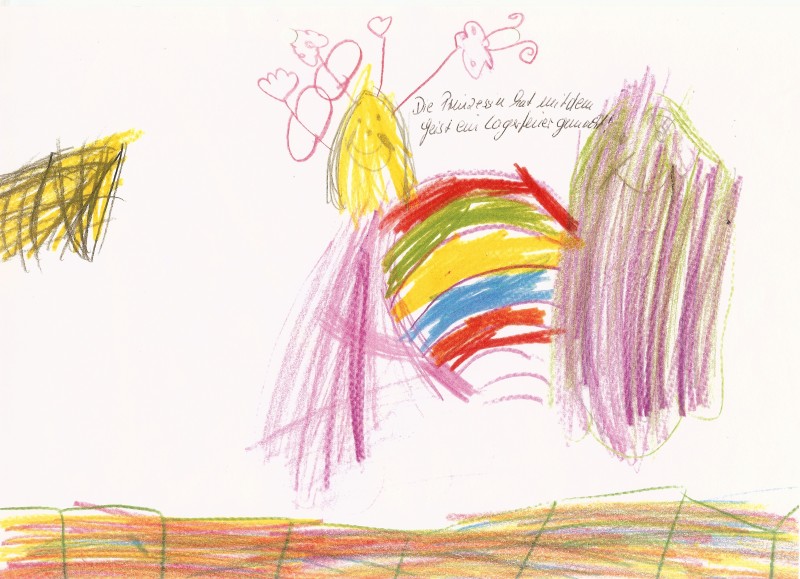
Immediately after we finished the story, I asked her if she would like to paint the first picture. She spontaneously agreed and said: „I paint Bäger Castle!“ She sat down at the painting table and painted with great concentration. She told the other children at the painting table why she is now painting the castle. She said, „It’s my own castle and it’s pink!“ I found her very self-confident at that moment.

In the next few days we selected together which parts of the story she wanted to illustrate. In addition to Bäger Castle, she decided to paint Princess Shuga, the King and Queen, friends, friends, the parents‘ office and the children’s sleeping places. Thus she began to independently complete further motifs from the story.

She’d come to me every time before and say, „I’m going ahead with our project!“ When I asked her what she wanted to paint, she could immediately name the motif. So she said: „Today I paint my friends or the king and the queen!“ Then she went to work very purposefully.
It took her an unusual amount of time to finish the picture of the princess’s friends. I got the impression that it might have been too much for her and asked her if she would like to ask a child to help her with the design of the pictures. She shook her head vigorously and said: „I want to do this alone!“ And that’s exactly what she did in the next few days until all the pictures were ready.

When we realized together that we had all pictures together, she proudly said: „Now I’m done!“ Exactly these words she had also mentioned during the completion of the story. I asked her if she would like to choose a nice ribbon to tie the individual pictures together to a book.
She nodded happily and we went to our cupboard with all the ribbons.

It took her exactly 7 minutes to decide on a ribbon. I made her various suggestions, but she just shook her head and said every time: „I don’t want that!“ I let her choose on her own and she chose and chose. When she made up her mind, she came to me with the tape and said: „Let the book look like this!“

She connected the individual pictures very carefully with the ribbon and made the ribbon herself. Then she looked at her work for a while and laughed at me. She seemed very proud and happy of me at that moment.

I asked her which children she would like to present her book to and with which children she would later also like to perform it as a small play in the whole group. She named the children: Annett 4;9, Lale 4;5, Hanna, 5;6, Nele 4;11, Patrick 4;9, Mia 5;8.

I asked her if she wanted to tell the story herself. She shook her head hard. I suggested that she read the story and show her the pictures. She accepted this offer.
The next day Rachel and I asked the children mentioned if they would like to participate in this action. Here I left it to Rachel to explain it in more detail.
She said: „I made up a story and drew pictures, which I will show you and then play theatre.“

The children listened to Rachel in great concentration. I explained to them that I would read the story and Rachel would show the pictures. I made eye contact with Rachel to make sure that she would stick to her decision to show the pictures. At my questioning look, she nodded her head.
I started to read the story and Rachel was very concentrated in showing the right pictures at the right moment. The children reacted positively to their first picture; so Hanna (5;6) said: „But this is a beautiful castle!
I could see from Rachel’s radiant face how well the children’s confirmation did her.
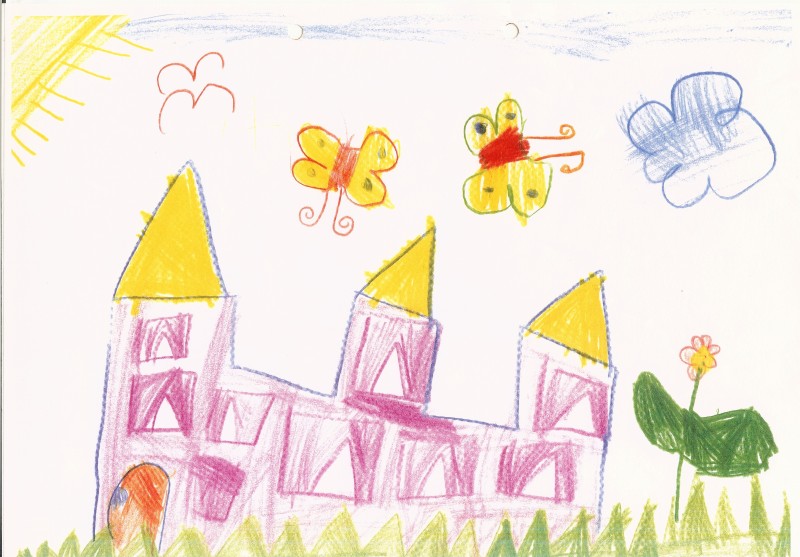
She showed the other pictures proudly and self-confidently. Asked by Nele (Nele asked Rachel directly if the friends live and eat in the castle, Rachel replied: „Yes, they eat and live in the castle with the princess“. The answer came immediately, without hesitation and very definitely.

Here are two more pictures from the series:

When the story was over, I asked the children how they liked the little story and the children answered: Yes, that was beautiful!

Rachel was a bit embarrassed, but was visibly pleased. When I asked them if they could imagine making a little play out of this story, they were all very happy and interested – and Rachel screamed especially loudly.

The children found out that we need costumes and crowns for the king and queen. Rachel suggested that the princess’s friends should still play „Sleeping Beauty. The other children were enthusiastic about the proposal and so the Sleeping Beauty game was included.

I explained to the children that the next day we could start making the costumes or searching from our stock.

Reflection:

I think I’ve managed to give Rachel more confidence in her abilities. The positive reinforcement of her ideas and plans has, I think, given her more security. It was also a very important experience for Rachel to feel at the centre of the action with her own contents and to feel this as positive and pleasant. The positive reaction of the children made Rachel visibly happy and braver.
I also liked the fact that she only painted the pictures she thought she needed and that she always got her way with further proposals from my side.
It was important to me that she tried to represent her contents and ideas to the outside world by naming her project in front of others without – as so often in such moments – withdrawing or refusing. So far, she has succeeded in keeping her enthusiasm and self-confidence high (with the exception of small uncertainties).

Implementation phase 3:
Costumes and props are thought about, they are produced, the role play is rehearsed.

I want Rachel to be encouraged in her creativity by expressing her ideas for the design of the costumes and props and by selecting and producing the materials, costumes and props with me and the other children.

Rachel and I gathered the children of the small group to explore our costume collection in the basement. Here it became clear that Rachel had very clear ideas about what the figures should look like. When I suggested a dress for the queen, she said: „No, I don’t like it, the queen should wear a flowered skirt and a pink blouse.“ So we looked for a floral skirt together, but we didn’t find a blouse that was pink, which obviously upset Rachel. She started complaining: „This is stupid, I don’t want it that way!“ She shook her head in anger at my other offers regarding the queen’s outerwear.

Then I remembered that I had a pink blouse in my closet at home. I suggested this solution and asked her if it would be okay with her. She nodded her head and her mood suddenly improved. She laughed again and helped to find the other costumes. The other children had found a red velvet cape for the king and different clothes for their friends.

As a princess (it was clear to her that she was the princess) Rachel was looking for a yellow tulle skirt and the matching top. We went back to the group room, put the costumes on the tables and the children started to distribute the roles on their own. Patrick was the only boy to become king, Hanna the queen and Annett, Lale, Nele and Mia the friends.

Then we decided together which props we still needed. Rachel said: „We need three crowns“. She immediately agreed to make the crowns. Nele suggested making red capes for the friends.

In the cellar we had found an old scenery with a landscape with two houses. Looking at the background, Rachel stated: „We are turning the yellow house into a castle. We cut out a lock and stick it over the house.“ We collected the different materials together: Gold foil for the crowns, red crepe paper and ribbon for the cap, pink paper for a pink lock. When we had everything together, I explained briefly how the cloaks could be made and that we would have to paint the outlines of the castle on the paper.

Rachel said she knew how to make a crown. The children started working. After a short time Rachel asked me for help, because she had problems to paint the teeth of the crown. I showed it to her, and she finished the task on her own.

While the children were working, they talked about the fairy tales they knew and told each other about the content. Rachel also entertained her desk with her knowledge, while she was able to reproduce the contents of the fairy tales very precisely. There was a concentrated, intense, themed and cheerful atmosphere among the children.

But then everything changed!
The group door opened and Hanna’s mother came in. Hanna had probably told about the upcoming play at home and her mother was so enthusiastic about it that she picked out all her carnival costumes. She stood there with an arm full of pink princess dresses, fairy robes, girl dreams made of tulle and lace and a frog with huge eyes of faith.
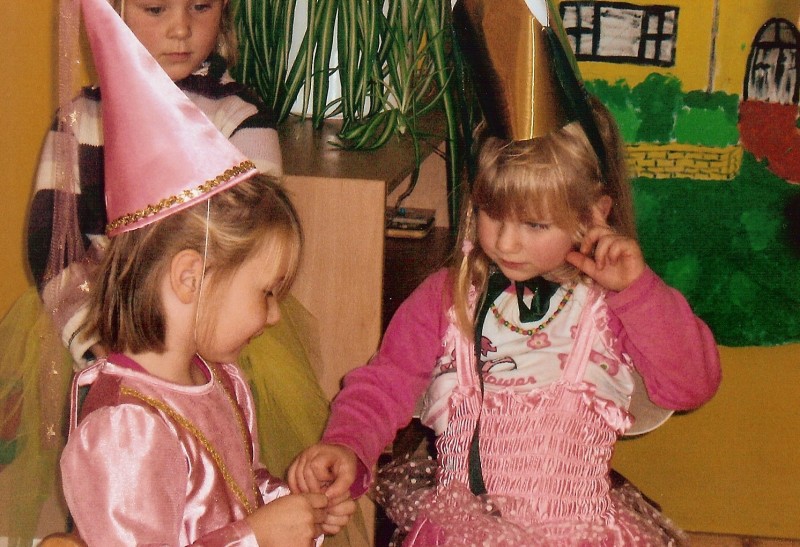
She beamed and asked if we could use the clothes for the play. Before I could say anything, the children came running to her with loud screams and tore her clothes almost out of her hands. Rachel was just as enraptured by the sight of the dresses and chose a pink dress with smocked top and white lace in the skirt. The children started to put on the clothes, helped each other to close the costumes and then started to play the story. They gave each other tips as to who should stand or go.

Hanna’s mother stood next to me and was happy. I, on the other hand, didn’t know whether to laugh or cry. But the children’s enthusiasm was so great that in my opinion an interruption would have been criminal. Rachel was roaring through the room in her pink lace dress on a bobby car, screaming again and again:

„I am Princess Shuga!“

I’ve rarely seen Rachel solved like that.

The other children danced around her, and the king and queen sat worthily in front of the not yet existing castle. I let the children have their way. After the spontaneous zeal had subsided, the children asked Hanna’s mother if they could continue to use the clothes for the game. Hanna’s mother answered in the affirmative and I fired a mother who felt that she had done a good job.

When the mother left, I asked the children if they really wanted to use these clothes for the game and not those they had chosen themselves. Rachel was the first to say, „I want to wear this dress, it’s much nicer!“ The other children joined and I gave in. The clothes were unbeatable. Then I told the children that although they now had beautiful costumes, even the princess’s friends now had such beautiful dresses – we no longer needed the capes – the castle was not yet finished.

„We need the castle for the story“, Rachel said. Together we decided to finish the castle the next day in free play. Because now we didn’t have time because the children were picked up.

Reflection:

I think I’ve only achieved my goal of encouraging Rachel’s creativity to some extent because of the situation. Although she completed the crowns and later worked on the completion of the castle, the costumes she had chosen, which were actually intended to express her ideas, did not come into their own.
Maybe the clothes that Hanna’s mother brought with her, but also simply met her taste more and she could do a lot with her friends, who looked like fairies and dancers. Anyway, her joyful detachment pointed to it.

On the one hand, I found it a pity that the beautiful „working atmosphere“ was interrupted by the arrival of Hanna’s mother, on the other hand I found the children’s enthusiasm and the spontaneous implementation of the story very impressive. It was also nice to see how independently they helped each other. I was also pleased how naturally Rachel took on her role.

As far as linguistic support is concerned: Rachel’s narrative pleasure found room
and she used it extensively to convey her fairy-tale knowledge. I have the impression that she is becoming more courageous in sharing her knowledge with the children, although she seems to pay less attention to how the children react. I think that’s a small success.

Ideas:

Before the next activity (performance in the whole group) I would like to ask Rachel if she would like to label her painted pictures.

Implementation phase 3 a:
The pictures are labeled

When Rachel came to kindergarten the next morning, I asked her if she wanted to write something about her pictures as she knows it from a picture book. She was happy and said: „Yes, but I want to do it in your office and you have to prescribe it.“ I promised her my help and we went to the office. Or rather, she happily jumped after me. We looked at the pictures and Rachel told me what she wanted to write about them.

I wrote her the individual sentences. Then she started to rewrite the letters, and when she had finished the first letters, she really said to me radiantly: „I’m writing a book!“
I said: „Yes, you are writing a book.“

Then she called out to every child in the hall:

„Come here, look, I’m writing a book! I’m writing a book!“

It was extremely easy for her to rewrite the letters, and her joy was immense. I will promote their pronounced relationship to letters even more specifically in the near future.

And this is the story Rachel dictated in the office:

„A princess floats into the castle. The castle is called Bäger and is pink. There is a treasure chest in the castle. The princess is called Schuga and has a pink dress on with flowers and stripes at the hem and the dress sparkles. Her hair is red. It’s a child princess and she’s playing.

She plays bobby car driving, that’s what she likes best. Her friends also live in the castle. You’re wearing red sweaters and yellow pants and pink shoes. But driving Bobbycar always makes the princess alone. When she wants to play with her friends, she calls everyone. Everybody’s nice to her and they don’t quarrel. The princess’s parents also live in the castle and they like it when the princess laughs and has fun.
The princess has so many toys in her room that she has no room left. When you go down the stairs, there’s Mom and Dad’s office. Books, shelves and children are sleeping behind the shelves. There’s also a play corner in the office. The children can always choose a bed to sleep in. Behind it is the bathroom, then comes a door, there sleeps the adults. Now the children and the princess are playing „shoe salad“ and the story is over.“

Implementation phase 4:
Rachel and the small group play the history of the whole group

With the performance in the whole group I would like to achieve that Rachel loses her shyness to speak in front of the whole group. That’s why she should announce her story to the children herself before the performance. The small group she has been working with all this time should give her security. I want her to feel that the other children like her ideas and ideas and that it can be a pleasant feeling to be in the centre of attention thematically. I want to strengthen her self-confidence by proudly experiencing that it is her story that is now being shown as a small play.

Implementation:
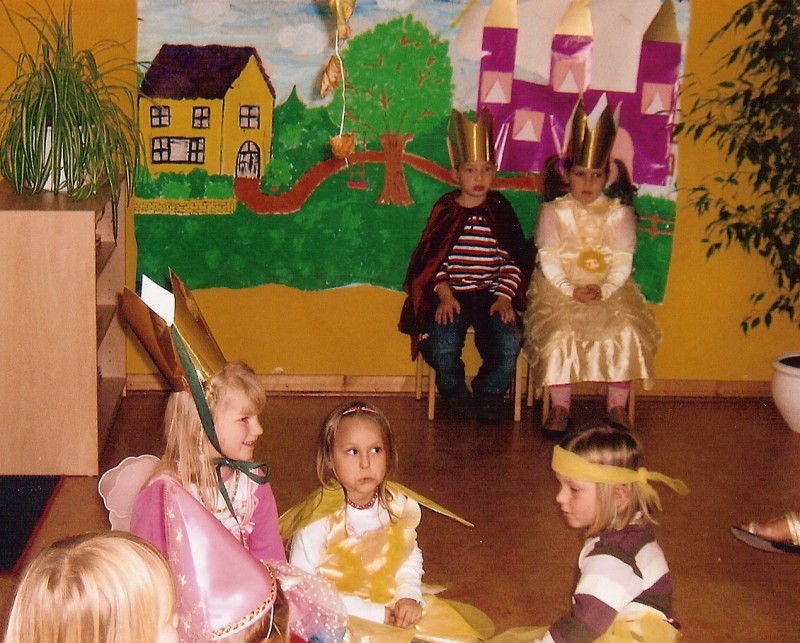
On the day of the performance Rachel came very excitedly to the kindergarten. She greeted me with the words: „Today is my performance.“ I enjoyed that she could really see the little play as hers. We fixed the finished castle on the scenery, then the children played until it was time to change for the play.

When the time came, I asked Rachel to call all the children involved. An excited swarm of children (especially Rachel) arrived at the office. I asked Rachel to tell the children before the performance that it was her story she made up.
Here I wasn’t sure if I wouldn’t take a vehement no, but Rachel nodded and said, „I’ll tell them that.“

The colleagues had prepared a suitable music for our move in, and we entered the stage closed. Rachel sat on her bobby car and raced into the room like a wild horse, lifted the bobby car several times and then slammed it loudly onto the floor. The children stood next to each other and waited until the music was over. Then I gave Rachel a sign that she could start.

And she actually did. She said: „I made up a story and now we want to show it to you.“

The children applauded and the game began. Rachel seemed very self-confident and her requests to the other players to play the different games arrived clearly and safely.
The children played the story and Rachel led one or the other player into the necessary position. Rachel also took the lead in the jointly decided Sleeping Beauty game, which was also installed, and divided the players. At the end of the performance all the players bowed and the audience clapped. Rachel laughed all over his face and was visibly proud.
Total reflection:

I believe that the project as a whole has succeeded in promoting Rachel in the linguistic and creative field and at the same time strengthening her confidence in her abilities. In this project she had the opportunity to contribute her linguistic and creative strength. She could apply her joy of speech and narration at many points of the project. The invention of the story challenged their imagination and expanded their understanding of speech. With each phase of the project she became safer and more self-confident.

Her more and more relaxed behaviour in the small group was then also reflected in the whole group, when she came on stage very massively with the bobby car like a wild horse and presented herself as strong and self-confident.

I sometimes wondered if I had chosen the right project to support Rachel. For example, if I had taken a series of games to build on, the result would have been much clearer and more namable. But I come to the conclusion that this project as a whole was well suited to further strengthen Rachel’s personality, so that she becomes more courageous, trusts her knowledge and may also represent her knowledge and skills to the outside world.

I also believe that the feeling of being at the centre of her topic and experiencing recognition for it has given her the certainty to appear confidently before the whole group. I believe that Rachel’s professional development should be accompanied by the promotion of her personality in order to avoid withdrawal and refusal.

To see how other children of extraordinary ability (with an estimated IQ above 115) have found theatre play, read:
Examples for Drama Activities at Kindergarten
and
Theatre Play with Gifted Children.


Date of publication in German: 2014, February
Copyright © Hanna Vock, see imprint.


Chess

by Hanna Vock


Chess is a game that children find interesting if they have a great desire and particularly good ability to think abstractly and strategically. The rules of the game are simple, but the possible course of the game and the possible strategies are incredibly varied.

The advantage is who can think complex and has a good memory. Think complex: think up the different possible next moves and the possible reactions to them, if possible even more than one move in advance. Good memory: remember what you have just thought up and juggle it mentally until the decision for your next move has been made. And have fun doing it!

This explains why many gifted children take an early interest in chess, provided they have someone who introduces them to it and get them excited about it.

The advantage of playing chess is that the game enables a demanding intellectual communication that is not bound to language.

Here is an example from a kindergarten:

Chess Club


Date of publication in German: 2010, August
Copyright © Hanna Vock, see imprint.


Chess Club

by Nazlι Baykuş


Through my observations on 5-year-old Peter, I realized that he would like to play chess, but did not openly say so. In the group of our school children (aged from 6 to 10) we had three older children with the same interest. So I brought Peter together with the older children and suggested to the children to found a chess club. Christian from the kindergarten (children from 3 to 6) also showed that he could be interested in it, he also came to it.

First meeting

First meeting with the kindergarten children Peter (5) and Christian (6) and the school children Lukas (9), Manuela (8) and Philip (7).
I asked the children if they would like to start a chess club.

Christian (6): „A chess club? Where we always play chess?“

All the children agreed. They wanted to know whether they could start tomorrow. We arranged a planning meeting that could take place the day after next.

Two days later

Lukas, Philip, Peter (5) and I sat down in peace that day, the other two children were not there. All three children have collected ideas what they would like to do in the chess club. Lukas wrote down the ideas. Except for the point „Opening of the Chess Club“ all ideas came from the children. They then also determined the order on their own, I only had to give little help.

My suggestion was to open the chess club to other children. The children agreed – on the condition that this should be the last thing to happen.

Lukas wrote a poster for the parents with the following text thought up by the children, in which the children’s planning ideas are also reflected:

„Dear parents!

We have founded a chess club and have some plans. The following dates are important for this:

19. 2. Library. Please bring a child seat for the car.
23.-27.2. Set up the chess club room.
1. 3-5. 3. Building a chess board and chess pieces.
8.-12.-3. Games against each other.
15.-19.3. Visit a chess club.
22.- 26.3. We are chess pieces the day long.
2. 4. Invite a chess professional.
Date to be announced: Chess against parents.
Date to be announced: Opening of the chess club.
Please pick up your child on the above days from 4 pm.

The Chess Club: Lukas, Philip, Peter, Christian, Nazlı.“


It will also become apparent that it took a while before the project really got going and filled the children with more and more enthusiasm. I carried out this project in the initial phase of my further training to become a specialist in the advancement of gifted kindergarten children (IHVO-Certificate-Course).

Today I know that I should have started differently: just start playing chess and don’t stop me and the children from doing too much preparatory work; because the children wanted to play chess and not do everything else, but at the beginning of this project I went the cumbersome way… I’ll write it down the way it was.

19.2. Library

We originally wanted to go to the library to borrow books about chess rules. But this did not work, because 3 children (Peter, Christian, Philip) were absent this day. We have postponed the visit to another day.

23-27.2. Setting up a chess club room

The Snoezel room, which was no longer used so often by the children, was declared a chess club room; it was quite small, quiet and lockable.

The children photographed each other and me to make it clear that we are the founders and main actors in the chess club. The photos were attached to the clubroom wall.

The children also had the idea of putting a chess board and chess pieces on the wall. Two children painted 32 coasters with finger paints in black. Together with a black frame on the wall, the result was a chessboard picture.

A great, big chess board was brought along by my colleague from home. Now it was clear that we wanted to sit on the floor while playing. We got a carpet, seat cushions and two little tables for drinks.

The children did not produce the initially planned chess pieces for the wall. I had set a deadline of one week. When the deadline was over, the children said they didn’t want to put chess pieces up against the wall. Overall, the children showed little interest in decorating the room, I had to ask them about it several times. They had an exact idea of what the room should look like, but showed little initiative.

During this time I thought I missed the topic and put too much pressure on the children.

This turned to the positive with the building of the chess pieces.

1.3 – 5.3. Building chess pieces

I have adopted the idea of a colleague to build the chess pieces from clay flower pots. I provided the materials (clay flower pots in different sizes, wooden balls, paints and hot glue gun), and Manuela and Lukas developed what the figures should look like. All children discussed in which colours the figures should be painted. They chose white and blue, the club colours of Schalke 04, because they are all fans.

All five children enjoyed creating the figures. They immediately agreed on which figure should look like. As the children were very motivated to play with their self-made pieces, they set up the sitting area in the chess club room on the same day and played their first game. I think the kids just wanted to play without all the preparations around it.

I made another observation which was interesting for me: My opinion was that the pawns were not yet finished; I found, for example, that the jumpers should still get a ponytail made of wool: For me it was not only about the beautiful appearance, but also about the better distinguishability of the figures.

But the children grumbled and all felt that they could distinguish the figures so well, which they proved.

… and this is what our characters looked like.

8. – 12.3. Matches against each other

As a second action I had planned to go to the library with the children to get information about chess rules. However, this did not work for organizational reasons. So we threw our (little) knowledge together for the beginning.

Lucas (9) had played with his father before, and Peter (5) had played with his grandfather. Manuela (8) and I had little knowledge. Christian (6) and Philip (7) had never played chess before.

When we later went to the library, the interest in the books was very high.
I think that in the beginning the children played for the fun of playing and that this has changed with time to the urge of „real“ playing.

By chance we got a PC from a father during this time. Manuela’s grandfather gave us chess games for the PC, so we could also use the PC to play chess. This was very well received by the children. They used the room for several, but also individually.

The children enjoyed having a room to themselves. On the following days they also took the key and went to play chess. They could interrupt their game at any time because they could close the room.

During the children’s game it could be observed that Peter (5) learned new things very quickly; he was also able to anticipate moves very soon.

While playing with the children, Peter (5) learned new things very quickly; he was also able to plan trains ahead very soon. This was a sign for us that he showed talent here and that he needed further suggestions.

He came running into the kindergarten in the morning, always wanted to play chess right away and finally brought his mother to chess too.

And so it should go on:

„Dear parents of the chess club children!

We announce the following dates:
On Thursday, 25.3., we will visit the library to borrow books about chess.
On Friday, 26.3., we will visit the chess club „Schwarz-Weiß“ (Black-White). We meet at 6 pm at Alleestr. 122. You can pick up your child at 7 pm.
On Friday, 2.4., the chess pro comes to whisper secrets of the chess world to us.
On Thursday, 8.4., the time has come! Now you can play chess against your child in our chess club room accompanied by coffee and cookies. Of course, interested grandpas and grandmas are also allowed to participate.“


25.3. Library

That day we finally went to the library. The kids borrowed: Schachlehrbuch für Kinder (Chess textbook for children) by Markus Spindler and Tessloff’s Schachbuch (Tessloff’s chess book) by Daniel King.

By chance, there was a game of chess between two older men in the library. We watched until the end.

26.3. Contact to a chess club

A mother gave us the telephone number of the chess club „Schwarz-Weiß“ (Black-White). In addition to adults, children and young people between the ages of 12 and 15 also play in this club. We were invited right away.

At 6 pm we met in front of the chess club. The children sat down at the tables and started playing. Some also used the chess clock. They were also invited by the children of the chess club to play. Our children were excited, curious and showed a long stamina and a great concentration. They certainly suffered some defeats that evening, but the next day they played and practiced again in the kindergarten.

Next week we talked about this adventure in detail, the children liked it very much. Visiting a chess club was very interesting for them. Here they had the opportunity to exercise their common interest with children of the same age and older children. They had quick contact with the strange children. The companions of the association were very open and turned to our children. Philip (7) and Christian (6) declared that they absolutely want to join the club. Philip was actually registered.

2.4. The chess pro

Through a colleague I organized an appointment with a chess master, whom the children immediately called the chess pro. He’s been playing since he was six. The chess master played a game with the children. Lukas and Manuela played together against Peter and the pro. He explained his thoughts on the individual moves to the children during the game and gave them tips. It was a quiet atmosphere. The game lasted one hour, the children were concentrated the whole time.

The chess pro said he would like to come back again to see the children’s progress.

By visiting the chess pro the children learned new moves and rules, for example castling. They applied this again and again.

The kids had respect for the chess pro. The atmosphere was relaxed because the chess pro was very open and friendly towards the children. I had the feeling that he enjoyed being with the children. The children talked a lot about him later. At the parents‘ meeting the children also applied the newly learned methods and convinced their parents of the correctness.

8.4. Parent visit

The parents‘ meeting took place in a pleasant atmosphere with coffee, cocoa and cake and a lot of chess. All parents of the chess club children were present in the afternoon and on time. They used the chess room, the PC and three chess boards in the group room.

Some parents were excited, and some learned chess from their child. There were also games between adults in which the children stood by their parents with advice. There was a lot of enthusiasm. Some parents surfed the Internet to get new information.

13.4. Flyer and official opening of the chess club

The first step to the opening of the club was the creation of a flyer on a laptop. Lukas and Peter (5) created the flyer. I gave them help in handling the laptop. The children enjoyed experimenting on the PC.

We have distributed the flyer in the groups. We plan to send a flyer to each municipal kindergarten so that they can contact us and use our premises and knowledge. Unfortunately, no Kita has come forward, and nothing has come up to our inquiries either.

Then an official opening of the chess club took place, to which we had invited with the flyer. Children from the other groups, many parents and friends participated. There was also an intensive game between the Lord Mayor and the children.

The chess room isn’t as busy as it was at the beginning, but Peter and his four friends stick with it. Peter still plays almost every day, and our chess master continues to come by to guide and support the interested children.
Chess is now played in three out of four of our kindergarten groups.

With the project Chess Club I had the goal to bring Peter together with older children with the same interest. This has been achieved. He had the opportunity to pursue his interest, to acquire knowledge independently and to measure his skills against those of others.

An important goal has also been achieved for the entire kindergarten. Together with the children I have created a room where they have the possibility to play chess undisturbed. They have learned about other ways to express their interest outside the Kita.

Through the various project activities, the interest of some other children from my and other groups has now been awakened.

I really enjoyed the project and I think the children too. I will let the chess club continue running, as I think that there will still be children who are interested in it.


Date of publication in German: 2010, August
Copyright © Hanna Vock, see imprint.

Datenschutzerklärung

Unser Online-Angebot enthält Links zu anderen Websites. Diese Datenschutzerklärung erstreckt sich nicht auf andere Anbieter. Wir haben keinen Einfluss darauf, dass deren Betreiber die Datenschutzbestimmungen einhalten und übernehmen daher auch keine Verantwortung für Richtigkeit, Aktualität und Vollständigkeit der dort bereitgestellten Informationen.

Which Toys Do Gifted Children Need?

by Hanna Vock


Again and again I am asked by parents and kindergarten teachers:
Which game material would you recommend?

Simple question, difficult answer.

Most kindergartens have a well thought-out pool of proven play material and select new ones according to proven criteria.

In order to enrich this pool with play material that appeals to gifted children and takes them further, a few additional considerations make sense.

1)

Experience has shown that gifted children love games that other children of their age find (still) too difficult.

2)

Is there enough difficult play material available in the kindergarten for the children of extraordinary ability and for the gifted children?

For example, board games offered for children from the age of eight are often interesting for gifted children as young as four or five – and should be in stock, even if the not gifted six-year-olds are not yet interested in them or have nothing to do with it yet.

A list of interesting game materials, which is constantly updated, can be found here: Interesting Games (German version).

Please also note the list Picture books, Non-Fiction and Stories (German version).

3)

Is it guaranteed, for example, that a three-year-old child, who is gifted, has easy and natural access to the play material that is „actually“ intended for the elderly?

Prerequisite: It proves that it handles the material carefully.

4)

From the almost conspicuous abundance of games and materials on the market, not too little for the gifted children, but also not too much to choose – to achieve this, you have to be „close to the child“, know what it is dealing with emotionally and mentally, which helps it (in its current stage of development) to understand the world better now.

5)

Also the high talents of the children are different. Some have developed special interests, some deal incredibly intensively with abstract patterns, structures, strategies, others want to explore the environment in concrete terms, others experiment with language, with stories and role play.

It goes without saying that they need different materials.

Here, too, it is best to talk to the children about things that interest and fascinate them. Then the ideas (which also take into account the individual preferences of the children for certain play activities and learning paths) come of their own accord.

6)

In addition to a well-thought-out pool of difficult game materials, difficult game material should be made available according to the situation – in accordance with the themes and projects in the kindergarten.

7)

Often the things that appeal and satisfy gifted children are easy and cheap to obtain. There are often also „things from the adult world“, such as calendars, measuring instruments, old household appliances…

Also, existing, simple games can be adapted by newly devised more difficult rules of the game.

8 )

With all the care that the provision of game material requires:

The most important thing for gifted children is the teacher’s interest (mother, father, granny…) in the child’s thoughts, feelings, questions.

The most important play and learning material for many gifted preschool children is constant conversation with clever, supportive older children (or even peers or younger children) as well as doing things together in which „one can experience/learn something new“, „can copy something new“ (original sound of gifted preschool children).


Date of publication in German: 2010, July
Copyright © Hanna Vock, see imprint.

A Cognitive Approach of Pacification

by Annika Hensel


The five-year-old (tested) gifted Ben had an accident in the kindergarten. When he climbed on the horizontal bar on the outdoor area, he slipped off and banged his face in the ground. His nose was bleeding badly and he was screaming in pain and terror.

I just happened to be nearby and I was the first one with him. I tried to calm him down, carried him inside and sat down with him. A colleague brought a gauze bandage to stop the heavy bleeding.

Ben was very upset and screamed and cried because he was bleeding so much. He kept screaming, „It’s bleeding!“

Since I knew Ben was quite rational and able to understand an explanation, I told him that it would be better if he calmed down, because then his heart would beat slower again. The heart pumps the blood through the body – and the nose would certainly stop bleeding faster if the heart was not pumping so much.

He understood it immediately and I could sense him trying to calm down, which he did well in spite of his obvious fear.

Nevertheless, his nose was still bleeding heavily, so a colleague and I decided to call the ambulance. This I tried to tell Ben carefully. But he was beside himself with fear and shouted he didn’t want an ambulance – he only wanted to see his mother.

Again I explained to him that a colleague had already called his mother and that I would never allow us to go to the hospital without his mother. (We knew she could be there very quickly because she works nearby.)

He calmed down a little, but he needed more soothing.

Once again it became clear to me that Ben, being gifted, is much better at assessing things than other children of his age. He will understand the possible consequences of an accident much better than other children and therefore tends to be just the more frightened.

My awareness of Ben’s giftedness helped me reassure him with factual explanations. I told him that I wouldn’t let him go to the hospital alone and that I wasn’t allowed to, because I had signed a contract with his parents saying we would always look after him when he is in kindergarten. And many other things, too, about the ambulance and the hospital examination I explained to him.

Of course, he was still scared, but didn’t panic anymore. He clung to me and waited for his mother to come. Although the paramedics arrived before his mother, he no longer panicked.
Finally it became clear how much Ben feared hospitals, but also that one can help him reduce his fears by way of factual explanations.

More about Ben:

Establishing a Relationship with a Gifted 5-Year-Old (German version)

The Story of Philippus (German version)

See also:
Timidity and Apprehension in Gifted Children


Date of publication in German: February 2016
Translation: Arno Zucknick
Copyright © Annika Hensel, see imprint